

Pastoralism is an ancestral method of livestock farming, in which herds feed by grazing on the natural resources provided by the wild rather than those cultivated by humans.
By adapting to what nature provides, it is an extensive form of livestock farming that enables herds to be fed throughout the year as the seasons change. But pastoralism also involves:
- Maintaining the landscape: meadows, forest edges,
- Sharing nature amongst users (tourists, residents, outdoor enthusiasts, workers, etc.)
- Help in combating natural hazards, such as fire and avalanches: by grazing, the animals prevent vegetation from growing too densely, which could result in highly flammable vegetation in summer and unstable snow layers in winter.
- A genuine culture passed down through the generations.
Throughout human history, there have always been guard dogs… and always for the same reason: to protect and alert in the event of danger.
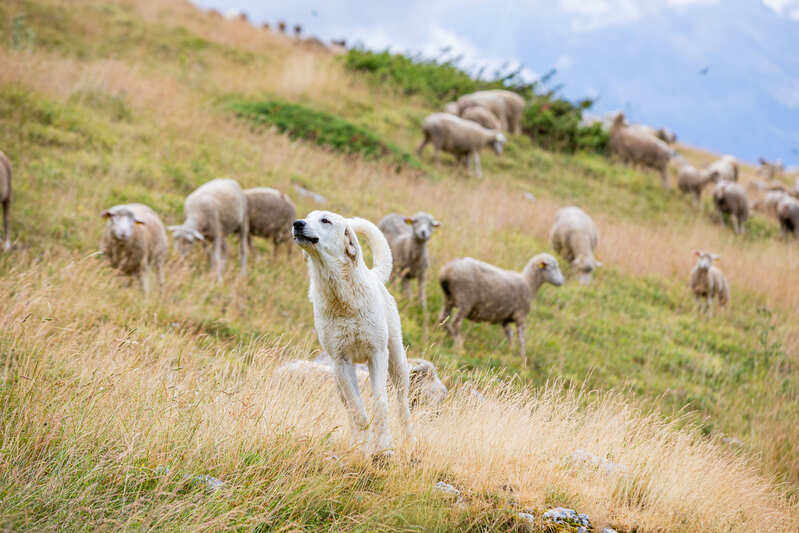
In recent years, with the return of the wolf, it has become essential for shepherds and livestock farmers to work with guard dogs, which protect the flock and alert the shepherds in the event of a wolf attack...
To give you an idea of the extent of wolf predation on domestic flocks, visit Map Loup.
Les chiens de protection naissent et grandissent au milieu des animaux qu’ils auront à défendre. Ils développent avec eux un attachement très fort, ce qui explique qu’ils ne quittent jamais leur troupeau et qu’ils soient extrêmement vigilants face à toute présence étrangère.
Lorsque vous approchez d’un troupeau, le chien vous perçoit d’abord comme une menace potentielle. Il va alors s’interposer entre vous et les animaux et adopter une attitude impressionnante : posture ferme, poils hérissés, aboiements.
Cette réaction peut faire peur, mais il ne s’agit pas d’une attaque. Ce sont des signaux de dissuasion, destinés à vous faire ralentir ou changer de trajectoire. Comme sa vision est moins précise, le chien peut aussi s’approcher pour mieux vous identifier. Il cherche à comprendre vos intentions, pas à vous mordre.
Traverser un alpage demande donc des compétences et des comportements adaptés afin d’éviter la peur et les malentendus avec les chiens.
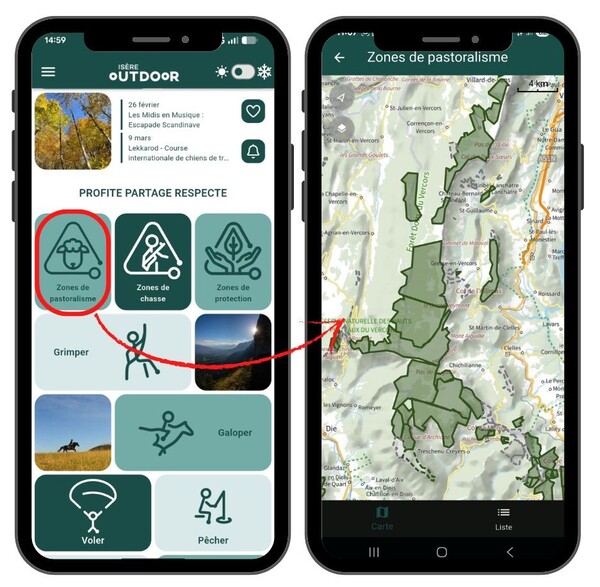
Here are a few things to do:
- AS SOON AS YOU SPOT THE HERD:
1) Speak loudly, make sure the dog or dogs can hear you: yes, indeed… You might be tempted to make yourself as small as possible in the hope that the dog won’t see you… but it will eventually spot you, and you’ll be closer to the herd. This will increase its anxiety and may trigger a more intense reaction on its part.
Let’s try to compare… would you rather see burglars approaching from a distance, or find them right there in your living room?
2) Try, as far as possible, to give the herd a wide berth: the further away you are from the herd, the less the dog will perceive you as a threat.
3) As soon as you hear a bark, even from a distance, pause for a moment: Once the dog(s) have spotted you, they will probably need to come closer to assess your intentions. They will run towards you with their fur bristling, barking, standing stiffly with their heads held high and chests puffed out; sometimes they may even bare their teeth.
- WHEN ENCOUNTERING A DOG
= its AIM: to intimidate you, and to show that it is ready to fight if you pose a threat to the pack.
= your aim: to behave in a way that reassures the dog of your intentions!
- When dogs come towards you, do not run away. Stop, stay calm and passive. Give them time to identify you.
- Do not hold the dog’s gaze: this is perceived as a sign of defiance.
- Do you have any sticks? Keep them close to your body: do you feel safe when someone points sticks at you?
- On a bike? Get off and hold it between you and the dog
- Rucksack: if it makes you feel safer, you can place your rucksack (jacket, hat) between you and the dog. But don’t try to push it away with it.
You can certainly speak to the dog(s) in a calm voice.
Generally speaking, anything that is threatening from another person towards you is also threatening to the dog: shouting, sudden movements, a generally defiant body language, throwing stones or sticks…
- WHEN THE DOG STARTS TO IGNORE YOU
Once it has sniffed you from head to toe (and it’s quite impressive!), the dog should start to show signs of de-escalation: a more relaxed gait, looking away, barking less, ignoring you as it returns to its pack …
You can then continue on your way at a slow pace, keeping the dog in your field of vision. Ideally, you should head in a direction that takes you round the herd.
The dog(s) may follow you until you have passed the herd. Let them accompany you, taking care not to turn your back on them completely (keep them within your field of vision).
Is it coming back again?! Let’s go back to the best practices!
Depending on the situation, you may not be able to go round the herd, and the dogs may not show sufficient signs of calm for you to consider crossing the herd. You cannot force your way through safely! In this case, it is advisable to give up and turn back to move away from the herd.
Herds often graze whilst moving. One solution may be to wait at a safe distance until the path is clear before continuing on your way.
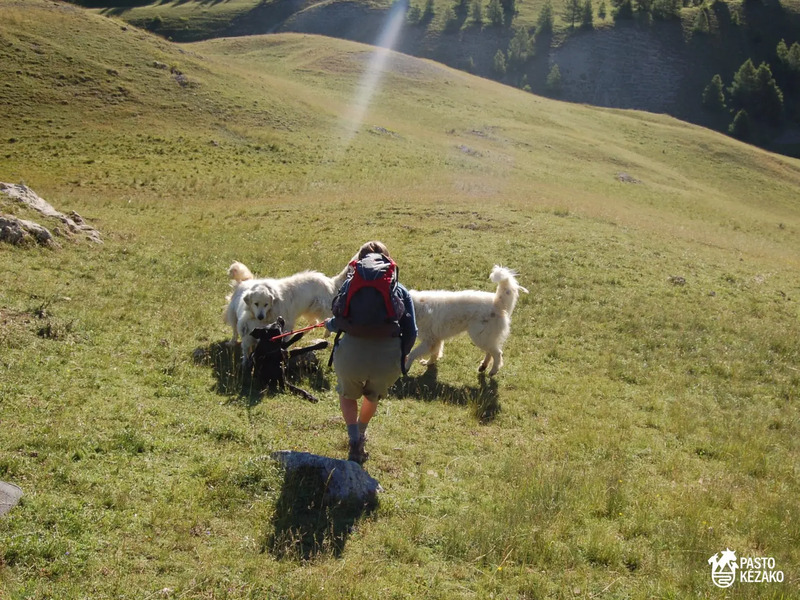
It is best to avoid taking a pet dog into pastoral areas guarded by livestock guard dogs.
But if you’d still like to head out into the countryside with your dog, visit Pasto-Késako to find out more!

the digital trails





The Isère Outdoor application was created
by the Département de l'Isère
Infos & contact
Conseil départemental de l'Isère
7 rue Fantin Latour
CS 41096
38 022 Grenoble cedex 1
Tel. 04 76 00 38 38
 Isère Outdoor - The mountain pasture : a shared space

